

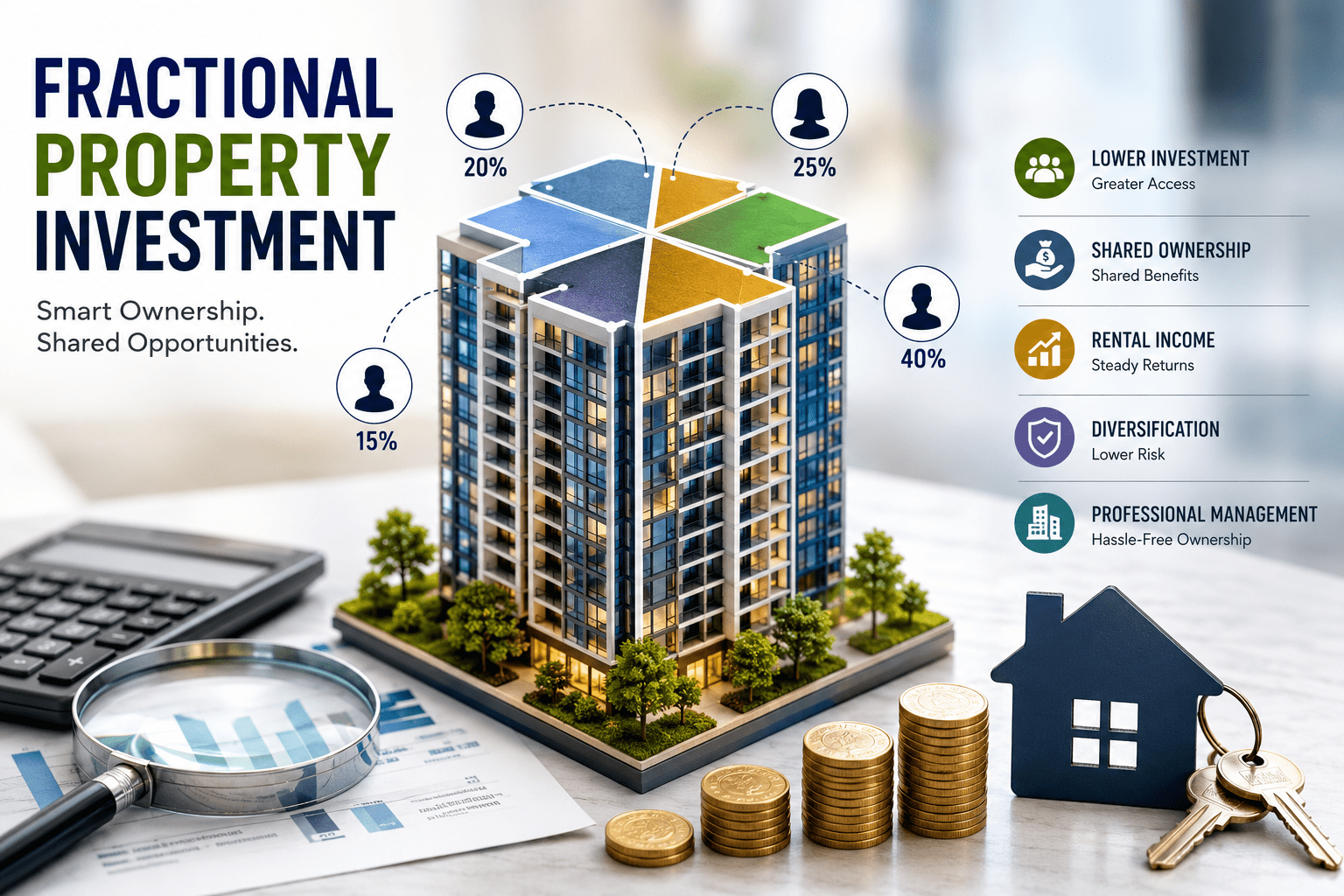
Fractional Property Investment in India: building real estate wealth, one share at a time.
Rising prices in Bangalore, Mumbai, Hyderabad, Pune, and Delhi NCR are pushing investors toward a smarter model — co-owning premium assets instead of buying them whole.
Real estate has traditionally been one of the most trusted investment avenues in India. But as property prices in metropolitan cities climb out of reach for many individual buyers, a new model is taking hold — one where investors pool capital to collectively own high-value assets, share by share.
In 2026, fractional ownership is transforming how Indians invest in commercial offices, retail spaces, warehouses, holiday homes, and premium residential properties. Investors can participate with relatively smaller capital while enjoying rental income, capital appreciation, and genuine portfolio diversification.
At 100 Yards, we help investors identify profitable real estate opportunities and make informed decisions through expert guidance and market insight.
01What is fractional property investment?
Fractional property investment is a real estate ownership model where multiple investors purchase shares in a property, each owning a fraction proportional to their investment — rather than buying the whole asset outright.
- Rental income, distributed in proportion to ownership share
- Capital appreciation as the underlying asset gains value
- Legal ownership rights tied to the share held
- Built-in portfolio diversification across assets
- A meaningfully lower entry barrier than outright purchase
A Grade-A commercial property worth ₹10 crore, for instance, can be divided among 100 investors — opening participation to anyone starting with just a few lakhs.
02Why it's gaining ground in India
Rising property prices
Premium properties in cities like Bangalore and Hyderabad have grown out of reach for many individual investors. Fractional ownership reopens access to these assets.
Growth of commercial real estate
Office spaces, IT parks, business centers, warehouses, and logistics hubs continue to attract institutional capital and strong rental demand.
Technology-driven investing
Digital platforms have simplified property discovery, documentation, ownership tracking, and rental distribution end to end.
Diversification benefits
Investors can now spread capital across several properties rather than concentrating everything in a single asset.
03Five trends shaping 2026
Commercial office spaces lead the pack
Grade-A office assets remain the preferred fractional category, backed by long-term corporate leases, stable rental income, lower vacancy, and strong appreciation potential.
Warehousing and logistics assets surge
E-commerce and quick-commerce growth is driving demand for logistics parks and warehouses across India's major hubs.
Holiday-home fractional ownership
Investors are buying into shares of luxury villas and vacation homes in India's leading getaway destinations.
PropTech integration deepens
AI-powered property analytics, blockchain-based documentation, and digital ownership records are making fractional ownership steadily more transparent.
NRI participation climbs
NRIs are increasingly using fractional investment to gain exposure to India's real estate growth story — without the burden of managing property directly.
04Types of fractional ownership models
Tenant-in-Common
Multiple investors hold ownership rights in a property, proportional to their investment share.
Special Purpose Vehicle
A company is formed specifically to hold the property; investors buy shares in that company instead of the asset directly.
Real Estate Investment Trust
Investors purchase listed units of a professionally managed real estate portfolio traded on stock exchanges.
Private Fractional Platforms
Technology platforms pool investor funds to acquire premium real estate assets on investors' behalf.
05Weighing the upside and the risk
Benefits
Risks
06Fractional vs. traditional ownership
| Factor | Fractional Ownership | Traditional Ownership |
|---|---|---|
| Initial investment | Low | High |
| Diversification | High | Limited |
| Risk exposure | Shared | Individual |
| Management effort | Low | High |
| Liquidity | Moderate | Low |
| Access to premium assets | Easy | Expensive |
07Taxation, in brief
Before investing, it's worth understanding how returns will be taxed:
- Rental income taxation on distributed returns
- Capital gains tax on eventual sale of a share
- TDS implications depending on structure
- GST considerations in specific ownership structures
Tax treatment varies by structure and investor profile — always consult a qualified tax professional before committing capital.
08Why Bangalore leads this market
Bangalore continues to draw fractional investors on the back of its IT and technology ecosystem, growing startup culture, strong office demand, expanding metro connectivity, rising rental yields, and ongoing infrastructure development.
High-demand investment corridors
09How to evaluate an opportunity
Property location
Prime locations generally drive stronger appreciation and rental demand.
Tenant quality
Review lease agreements and tenant profiles closely.
Rental yield
Compare expected returns against alternative investment options.
Exit strategy
Understand resale opportunities and typical holding periods upfront.
Asset management team
Evaluate the experience and track record of the people managing the property.
10The future of fractional ownership
"Fractional ownership is expected to become a mainstream investment category over the next decade, as transparency improves, regulation matures, and investor awareness grows across India."
As property prices continue to climb, fractional ownership offers an efficient way for investors to participate in premium real estate markets without needing substantial upfront capital.
End-to-end support, from research to transaction
100 Yards Realtor Pvt. Ltd. helps investors identify opportunities aligned with their financial goals while minimizing risk through informed decision-making.
11Frequently asked questions
Safety depends on property quality, legal structure, platform credibility, and the thoroughness of due diligence.
Minimum investments vary by property and the ownership structure used.
Yes, subject to applicable RBI and FEMA regulations.
Returns vary based on asset type, rental income, appreciation, and prevailing market conditions.
Yes — structures such as Tenant-in-Common and SPV models are legally recognised.
Professional asset management companies typically handle operations, maintenance, and tenant relations.