

Buyer's Guide
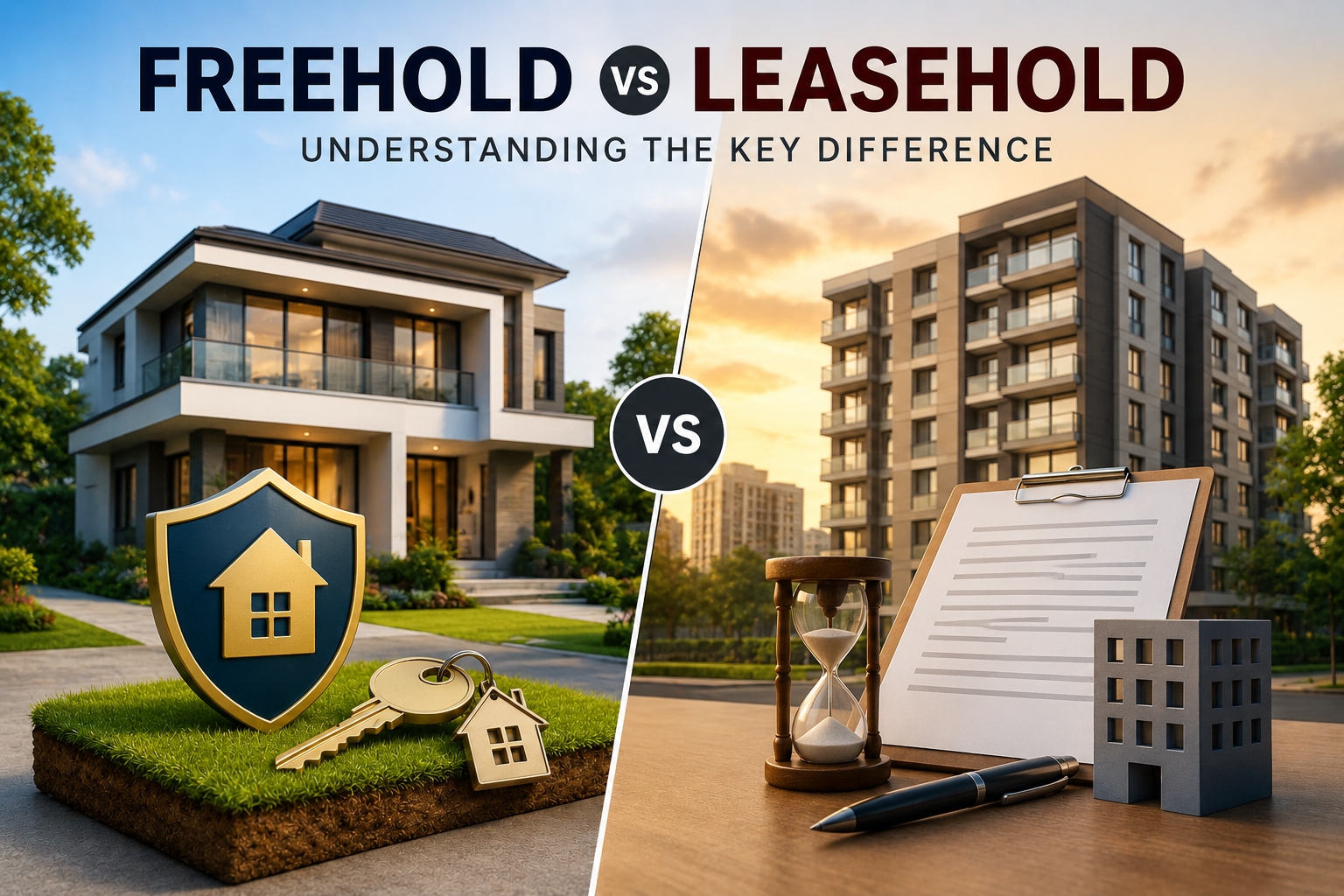
Difference Between Freehold and Leasehold Property
A complete guide for homebuyers and investors — ownership rights, tenure, costs, resale, financing, benefits and key risks explained.
Buying property is one of the biggest financial decisions most people make. While location, price, builder reputation and amenities often dominate the conversation, the difference between freehold and leasehold property is equally important.
The type of ownership attached to a property can affect how long you can hold it, what rights you have over the land, whether certain permissions are required for transfer or construction, financing considerations, resale potential and the overall long-term value of the investment.
For a homebuyer, investor, tenant or business owner, understanding freehold and leasehold property before signing an agreement can help avoid costly surprises later.
In simple terms, freehold ownership generally provides ownership of the property and the underlying land, subject to applicable laws and restrictions. Leasehold ownership gives the buyer or lessee the right to use and enjoy the property for a specified lease period under the terms of a lease agreement.
However, the actual legal position depends on the title documents, lease deed, local regulations and the authority that owns or administers the land. This guide explains the freehold and leasehold property difference, their advantages and disadvantages, costs, resale considerations, financing implications and the factors you should evaluate before purchasing either type of property.
What Is Freehold Property?
A property where the owner holds rights over the property and the land, generally with no fixed lease expiry date, subject to applicable laws, development regulations and easements.
What Is Leasehold Property?
A property held under a lease agreement for a specified period, where the land is generally owned by a lessor such as a government or development authority.
Common characteristics of freehold property
- Ownership is generally perpetual rather than limited to a lease term
- The owner typically owns the property and the underlying land
- There is no routine lease expiry date
- Resale and transfer are generally more straightforward, subject to title and local regulations
- The owner usually has greater control over the property
- The property can generally be inherited by legal heirs
- Mortgage and financing may be comparatively straightforward when the title is clear and marketable
The exact rights, however, should always be confirmed through the property's title documents.
Common characteristics of leasehold property
- Ownership or land rights are subject to a lease arrangement
- The lease has a defined tenure — often 30, 60, 90 or 99 years
- The lease deed establishes the rights and obligations of the parties
- Ground rent or other charges may apply depending on the agreement
- Certain transfers, mortgages, alterations or construction activities may require permission
- The value can be influenced by the remaining lease period
- Conversion to freehold may be possible in certain cases, but it is not automatic
The Delhi Development Authority provides mechanisms for conversion of certain leasehold properties into freehold subject to applicable conditions and conversion charges. This is why buyers should investigate the specific authority and property's conversion rules rather than assuming that every leasehold property can be converted.
Difference Between Freehold and Leasehold Property
The fundamental difference between freehold and leasehold property is the nature and duration of the rights held by the buyer.
| Factor | Freehold Property | Leasehold Property |
|---|---|---|
| Ownership | Generally ownership of property and land | Rights are governed by a lease |
| Tenure | Generally perpetual | Fixed lease period |
| Land ownership | Usually with the property owner | Usually retained by the lessor |
| Lease expiry | No lease expiry in the normal sense | Lease has a defined expiry |
| Transfer | Generally more flexible, subject to law | May require lessor/authority permission |
| Ground rent | Generally not applicable as lease rent | May apply |
| Construction | Subject to local approvals | May require additional lease-related permissions |
| Resale | Often simpler | Depends partly on remaining tenure and lease conditions |
| Financing | Often easier with clear title | Depends on lender, title and remaining lease term |
| Inheritance | Generally continues through succession | Rights can pass according to law and lease terms |
| Conversion | Not applicable | May be possible in certain cases |
| Documentation | Sale deed/title documents and approvals | Lease deed plus title and authority documents |
| Long-term control | Generally higher | Governed by lease conditions |
This table provides a general comparison. The actual legal rights should be determined from the title documents and applicable local laws.
Difference in Ownership Rights
With freehold property, the buyer generally obtains ownership rights over the property and land, subject to applicable regulations. With leasehold property, the buyer obtains rights defined by the lease agreement, and the lessor continues to retain the underlying ownership interest in the land.
This distinction can become particularly important when:
- Selling the property
- Applying for a mortgage
- Making structural changes
- Redeveloping the property
- Renewing the lease
- Transferring the property
- Passing the property to heirs
- Calculating the property's long-term value
Before buying a leasehold property, carefully review the lease deed rather than relying only on the seller's description.
Difference in Tenure
Freehold ownership is generally not limited by a lease expiry date — the property can remain with the owner and their successors subject to applicable law. Leasehold ownership, on the other hand, is linked to the duration stated in the lease agreement.
Suppose two similar properties are located in the same neighbourhood — Property A is freehold, and Property B has 85 years remaining on its lease. Even if both have similar construction quality and location advantages, a buyer may evaluate them differently because Property B's remaining lease period becomes part of the investment calculation. As the remaining lease period decreases, buyers may become more cautious about financing, resale and future value.
Difference in Costs
The purchase price is only one part of the total cost of owning property.
Freehold — buyers may need to account for
- Stamp duty
- Registration charges
- Property taxes
- Maintenance
- Applicable development or municipal charges
- Loan-related expenses
- Legal and documentation costs
Leasehold — additional costs may include
- Ground rent
- Lease renewal charges
- Transfer fees
- Permission charges
- Conversion charges
- Premium payable to the lessor
- Other authority-related dues
The cost structure differs significantly from one property and jurisdiction to another. For example, DDA's current information on leasehold-to-freehold conversion indicates that applicable dues and charges may need to be cleared before conversion is allowed. Therefore, never compare only the advertised purchase price — compare the total cost of ownership.
Difference for Resale
Freehold properties often offer a simpler ownership structure for resale because the ownership is not tied to a remaining lease period. Leasehold properties can still be resold, but the following factors can influence buyer interest:
A leasehold property with a very long remaining tenure in a prime location may remain highly desirable. Conversely, a property with a short remaining lease may require deeper due diligence and could have a smaller buyer pool.
Difference for Home Loans
Banks and financial institutions generally examine the property's legal title, documentation, valuation and marketability before approving a loan. For freehold properties, a clear and marketable title can make the documentation process comparatively straightforward.
Leasehold properties can require additional evaluation, including remaining lease period, lease deed, lessor's rights, transfer permissions, mortgage permissions, ground rent, outstanding dues, conversion status and applicable restrictions.
This does not mean banks never finance leasehold properties — financing depends on the lender's policies and the property's legal and financial characteristics. Before paying a substantial booking amount, ask the lender and a qualified property lawyer whether the specific property is acceptable for financing.
Benefits of Freehold Property
1. Long-term ownership
There is generally no fixed lease expiry date, making freehold ownership attractive for families planning to hold property for generations.
2. Greater control
The owner generally has greater control over the property, subject to zoning, municipal and other applicable regulations.
3. Easier resale
A straightforward title structure can make resale easier, provided there are no legal or documentation issues.
4. Inheritance
Freehold property can generally be passed to heirs according to applicable succession laws and valid estate planning documents.
5. Investment appeal
For certain investors, perpetual ownership can make freehold land and properties attractive for long-term capital appreciation.
Imagine purchasing a freehold residential plot in a developing locality. Over the next 15 years, infrastructure, employment opportunities and connectivity improve. Because the ownership is not tied to a lease expiry, you can continue holding the property without needing to worry about lease renewal. Of course, appreciation is never guaranteed and depends on market conditions.
Benefits of Leasehold Property
Leasehold ownership also has advantages and should not automatically be considered inferior.
1. Potentially lower entry cost
Some leasehold properties may be available at a different price compared with comparable freehold properties, although this varies widely by market.
2. Access to strategic locations
Government or institutional land may be offered under leasehold arrangements in established or strategically important locations.
3. Long-term lease options
Some leases provide substantial tenure, making them suitable for long-term residential or commercial use.
4. Possible conversion
Certain authorities permit eligible properties to be converted from leasehold to freehold under specified conditions.
5. Commercial applications
Leasehold structures can be relevant for commercial and institutional property where long-term use is more important than outright land ownership. The key is to understand exactly what rights the lease provides.
Challenges of Freehold Property
Freehold does not automatically mean risk-free. Buyers should still investigate:
A property can be freehold and still have title or documentation problems. Therefore, freehold status should never replace proper legal due diligence.
Challenges of Leasehold Property
Leasehold properties require additional attention because the lease conditions can directly affect ownership rights.
Remaining lease period
A property with 95 years remaining may be evaluated very differently from one with 20 years remaining.
Transfer restrictions
Some lease agreements may require approval from the lessor before transfer.
Ground rent
Check whether ground rent is payable and whether any arrears exist.
Construction restrictions
The lease deed may contain conditions regarding construction, alterations or property use.
Mortgage restrictions
Some lease agreements may require permission before creating a mortgage.
Conversion uncertainty
Never assume that leasehold property will automatically become freehold. Conversion depends on the relevant authority, policy, property category and applicable charges.
Which Is Better?
There is no universal answer. For many individual homebuyers, freehold property can be attractive because of its perpetual ownership structure and comparatively greater control. However, leasehold property can make sense when the location is excellent, tenure is long, price represents good value, transfer rights are clear and the documentation is clean.
Freehold may be more suitable if
- You want long-term ownership
- You are purchasing land or an independent house
- You want greater control
- You plan to pass the property to future generations
- You want to minimize lease-related restrictions
Leasehold may be suitable if
- The property offers a significant location advantage
- The lease has a long remaining tenure
- The price is attractive relative to comparable properties
- You have confirmed financing and transfer rules
- The property's legal documentation is satisfactory
Factors to Consider Before Buying
1. Verify the title
Check who legally owns the property and whether the seller has the right to sell it.
2. Read the complete lease deed
For leasehold property, do not rely on a summary or verbal explanation. Review the lease tenure, renewal provisions, transfer restrictions, ground rent, development conditions, subletting provisions, mortgage permissions and termination clauses.
3. Check encumbrances
Look for mortgages, liens, disputes and other claims against the property.
4. Verify government and municipal records
Confirm that the property matches the relevant land and municipal records.
5. Check outstanding dues
Verify property tax, maintenance, ground rent, authority dues and other applicable payments.
6. Understand conversion rules
If the seller claims that a leasehold property can be converted to freehold, ask for documentary evidence of the applicable policy.
7. Evaluate financing
Speak with your lender before assuming a loan will be available.
8. Compare total ownership costs
Do not compare only the sale price. Calculate: Purchase Price + Transaction Costs + Recurring Charges + Financing Costs + Lease-Related Costs
9. Consider your investment horizon
A person planning to hold property for 25 years may evaluate a lease differently from someone planning to hold it for 5 years.
10. Obtain professional legal advice
A property lawyer can review the title, sale documents and lease deed before you commit significant funds. India's Real Estate (Regulation and Development) Act, 2016 provides a regulatory framework intended to promote transparency and protect real estate consumers, but buyers should still conduct property-specific due diligence.
Practical Example: Comparing Two Properties
Suppose you are choosing between two apartments.
₹1 Crore
- Freehold ownership structure
- Clear title
- Strong location
- No lease expiry
₹90 Lakh
- Leasehold, 80 years remaining
- Annual ground rent
- Transfer subject to certain conditions
Property B is not automatically the better deal simply because it costs ₹10 lakh less. You should calculate financing cost, ground rent, transfer charges, legal costs, resale implications, remaining tenure, conversion possibilities and market demand. If Property B is in a substantially better location and its lease conditions are favourable, it could still be a compelling purchase. The decision should be based on value and legal rights, not simply ownership terminology.
Market Outlook
India's real estate market continues to evolve, with buyers increasingly paying attention to documentation, location quality, developer credibility, financing and long-term value rather than relying solely on headline prices. Knight Frank's India research continues to track residential market activity, buyer preferences and broader real estate trends across major Indian cities, highlighting continued residential demand and changing market dynamics across India's major urban centres.
For buyers, future property decisions are likely to focus more heavily on clear ownership documentation, regulatory compliance, infrastructure connectivity, quality of construction, developer credibility, financing accessibility, long-term resale potential, total cost of ownership and data-backed investment decisions.
How to Check Whether a Property Is Freehold or Leasehold
Do not rely only on the broker, seller or property advertisement — check the documents. Depending on the property, relevant documents may include:
- Sale deed
- Mother deed or previous title documents
- Lease deed
- Conveyance deed
- Encumbrance-related records
- Property tax records
- Mutation records
- Approved building plans
- Possession documents
- Authority allotment documents
- Conversion documents, if applicable
- No-objection certificates where required
If the property is leasehold, specifically identify: who owns the land, who holds the lease, how many years remain, whether the lease can be transferred, whether lessor or mortgage permission is required, whether ground rent is payable, whether it can be converted to freehold, and what conversion would cost.
Common Mistakes Buyers Should Avoid
Mistake 1: Assuming freehold means zero restrictions
Freehold owners still need to comply with local development and land-use regulations.
Mistake 2: Buying leasehold property without reading the lease
The lease deed is one of the most important documents in the transaction.
Mistake 3: Assuming every leasehold property can become freehold
Conversion depends on the relevant authority and applicable policy.
Mistake 4: Ignoring the remaining lease period
Tenure can have a direct impact on financing and resale considerations.
Mistake 5: Looking only at the purchase price
Recurring charges and transfer or conversion costs can change the overall economics.
Mistake 6: Skipping legal verification
Even an apparently attractive property should undergo appropriate title and document checks.
Frequently Asked Questions
01 What is the difference between freehold and leasehold property?
The primary difference is the nature of ownership. Freehold generally provides perpetual ownership of the property and land, while leasehold provides rights to use and enjoy the property for a specified lease period under agreed conditions.
02 Is freehold property better than leasehold property?
Freehold can be preferable for buyers seeking long-term ownership and greater control. However, a well-documented leasehold property with a long remaining tenure and a strong location can also be a good investment.
03 Can leasehold property be converted into freehold?
In some cases, yes. Certain authorities provide conversion schemes subject to eligibility, documentation and payment of applicable charges. Conversion is not automatic for every leasehold property.
04 Can I sell a leasehold property?
A leasehold property may generally be transferable subject to the terms of the lease, applicable law and any required permissions. Buyers should verify the transfer conditions before purchasing.
05 Does leasehold property have an expiry date?
Yes. A leasehold arrangement generally has a defined tenure. The exact duration is stated in the lease documents.
06 Can banks provide loans for leasehold property?
Banks may finance leasehold properties, but eligibility depends on the lender, remaining lease tenure, property documentation, title, permissions and other factors.
07 Is freehold property easier to resell?
It can be, particularly where the title is clear and there are no legal or regulatory complications. However, resale also depends heavily on location, price, property condition and market demand.
08 What happens when a lease expires?
The consequences depend on the specific lease deed and applicable law. Rights may terminate, be renewed or be subject to other arrangements. Buyers should never assume renewal terms without reviewing the contract.
09 Should I buy a freehold or leasehold property for investment?
The choice depends on your investment horizon, location, price, lease tenure, financing, expected resale demand and legal conditions. A professional property evaluation can help compare the two options.
10 How can I verify whether a property is freehold or leasehold?
Review the title documents, sale deed, lease deed, conveyance deed and relevant authority records. For a major purchase, have the documents independently reviewed by a qualified property lawyer.
Conclusion
Understanding the difference between freehold and leasehold property is essential before buying a home, land, commercial property or investment asset. Freehold ownership generally offers perpetual ownership and greater control, making it attractive to buyers looking for long-term ownership. Leasehold property, meanwhile, provides rights for a defined period and may come with specific conditions relating to transfer, mortgage, construction, ground rent and renewal.
Neither structure should be judged solely by its name. The smarter approach is to evaluate ownership rights, remaining lease tenure, location, purchase price, total ownership cost, financing availability, transfer restrictions, conversion possibilities, title quality, resale prospects and your investment horizon.
Most importantly, review the actual property documents and obtain appropriate legal advice before committing to a transaction.
Why Choose 100 Yards?
Choosing the right property involves more than finding a listing that fits your budget. It requires reliable information, local market understanding and support throughout the buying process.
Verified Property Listings
We help customers discover properties with relevant project and property information so they can make more informed shortlists.
Local Market Expertise
Our team understands the Bengaluru real estate market and the factors that influence different micro-markets, including connectivity, infrastructure and employment hubs.
Transparent Property Information
We believe property decisions should be based on clear and relevant information rather than pressure-driven sales conversations.
End-to-End Property Assistance
From identifying suitable properties to understanding project details and progressing through the purchase journey, our team provides assistance throughout.
Strong Developer Network
Our network provides access to residential projects and properties across Bengaluru and other relevant markets.
Data-Driven Recommendations
Instead of relying only on advertisements, we consider location, budget, property type and buyer requirements when helping customers shortlist properties.
If you are comparing freehold and leasehold property in Bengaluru, 100 Yards can help you explore suitable opportunities.